Nonlinear Model Predictive Control
New Gradient-based algorithm for NMPC
Gradient-based implementation of NMPC is interesting in some situations where on needs to adopt extremely small control updating periods. This can be the case for system with high uncertainties and very fast dynamics.
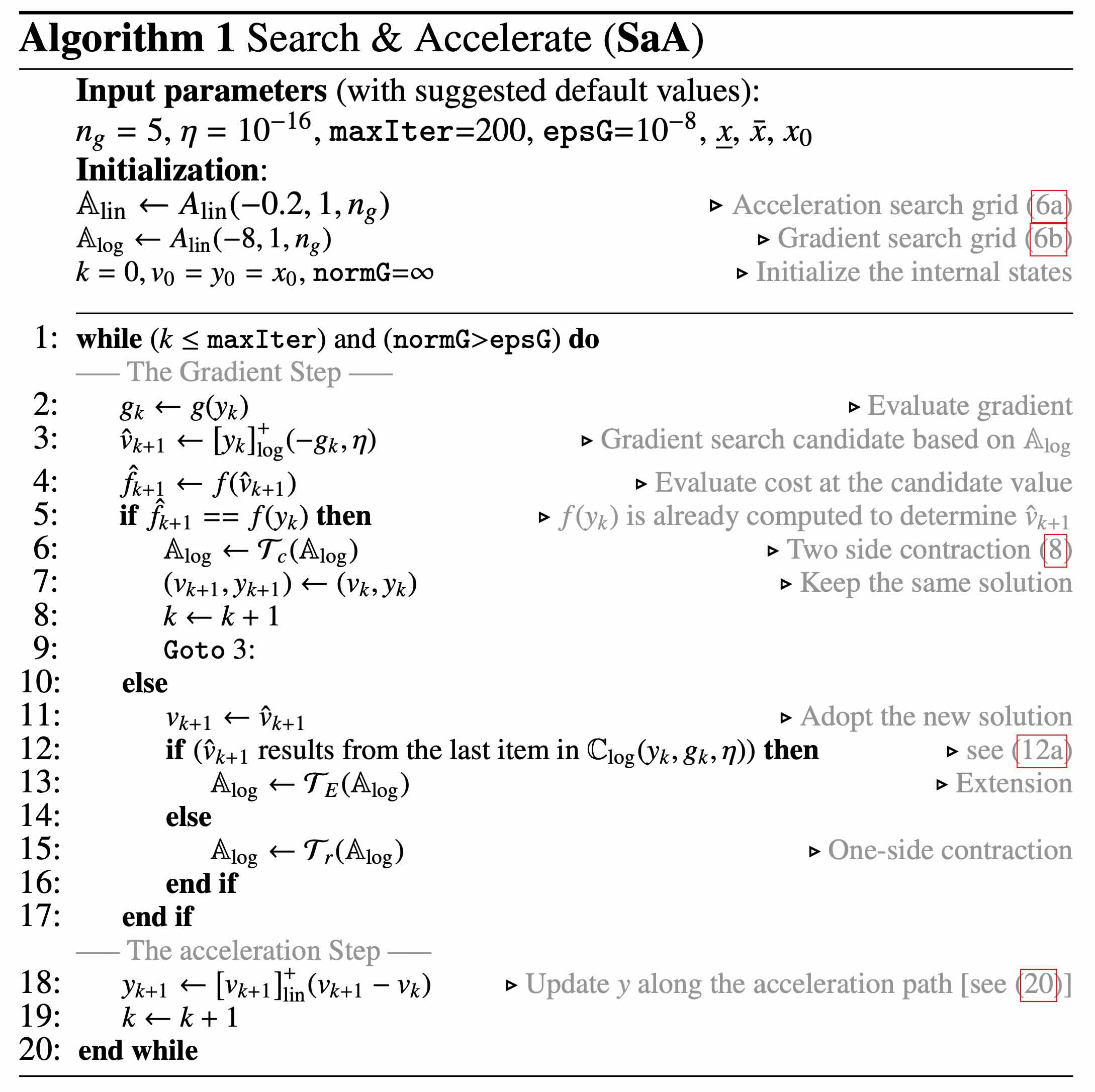
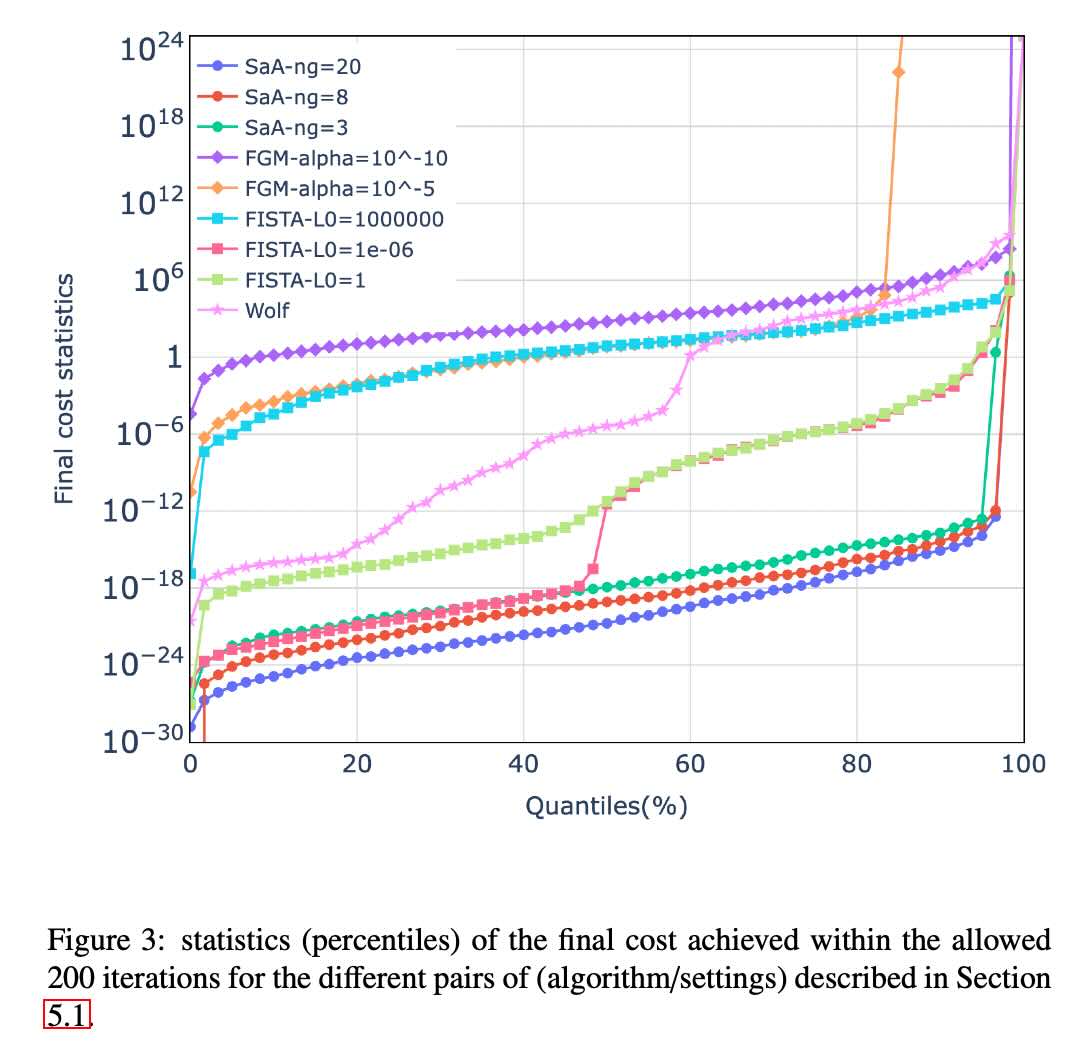
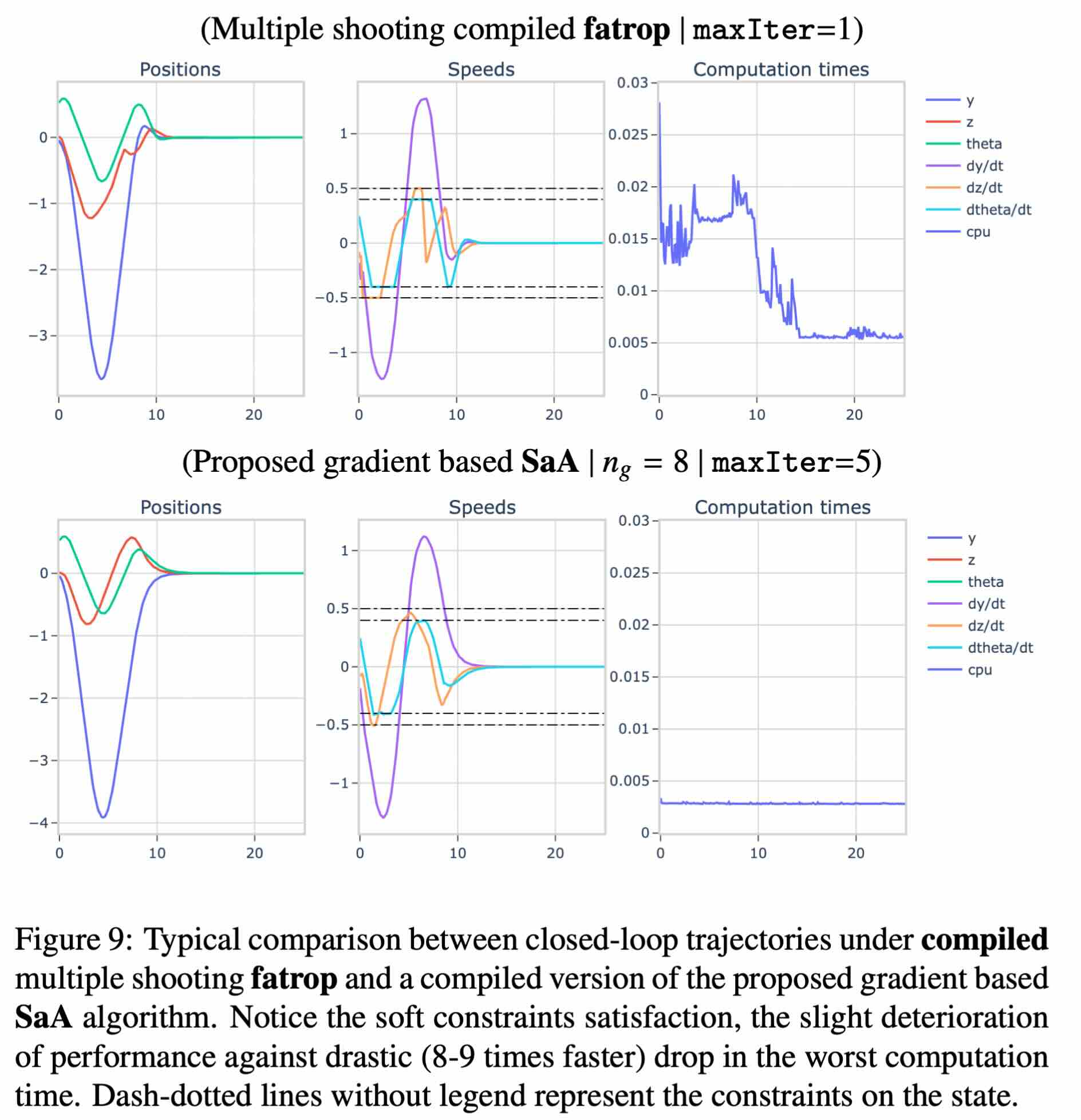
This paper discusses some aspects related to gradient-based optimization algorithms with special focus on the requirements associated to their use in the implementation of Nonlinear Model Predictive Control. Based on a dedicated discussion, a new algorithm, termed Search and Accelerate SaA is proposed that mixes together a novel line search, a trust region mechanism together with an adaptation of the gradient acceleration scheme. A dedicated benchmark involving a set of 600 instances of box constrained optimization problems is designed and used in order to show the algorithm performances which make it a highly competitive general purpose gradient-based alternative for box-constrained optimization problems. An appealing feature of the algorithm is its robustness to the choice of the few parameters involved in its definition making the default values a valid option for any problem without a priori knowledge of the related Lipchitz constant. Moreover, an example of use of the proposed algorithm in NMPC implementation is proposed showing the possibility to reduce the control updating period which might be mandatory in some circumstances.
The algorithm is based on a line search along the gradient followed by an kind of Nesterov acceleration step for wich another line search is implemented. Both line search are desgined such that stability is guaranteed.
For more details, refer to the [paper].
Provably stable formualtions
A major research topics is how to define formulation that are provably stable.
Relaxing the N-reachability assumption
The majority of provably stable formulations of NMPC requires the targeted state to be reachable at the end of the prediction horizon. This results relaxes this requirement.
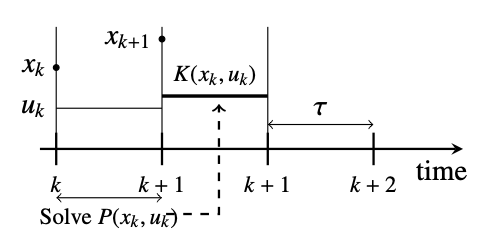
This paper proposes a proof of stability for Model Predictive Control formulations involving a prediction horizon that might be too short to meet the reachability condition generally invoked as a sufficient condition for closed-loop stability. This condition is replaced by a contraction condition on the stage cost. But unlike the contraction based existing formulations where the prediction horizon becomes a decision variable, the formulation proposed in this paper remains standard in that it uses constant and short prediction horizon. An illustrative example is provided to assess the relevance of the proposed formulation.
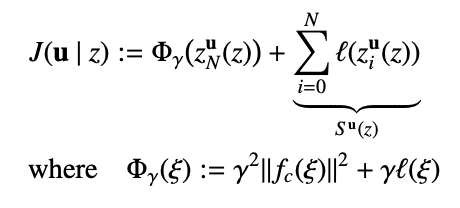
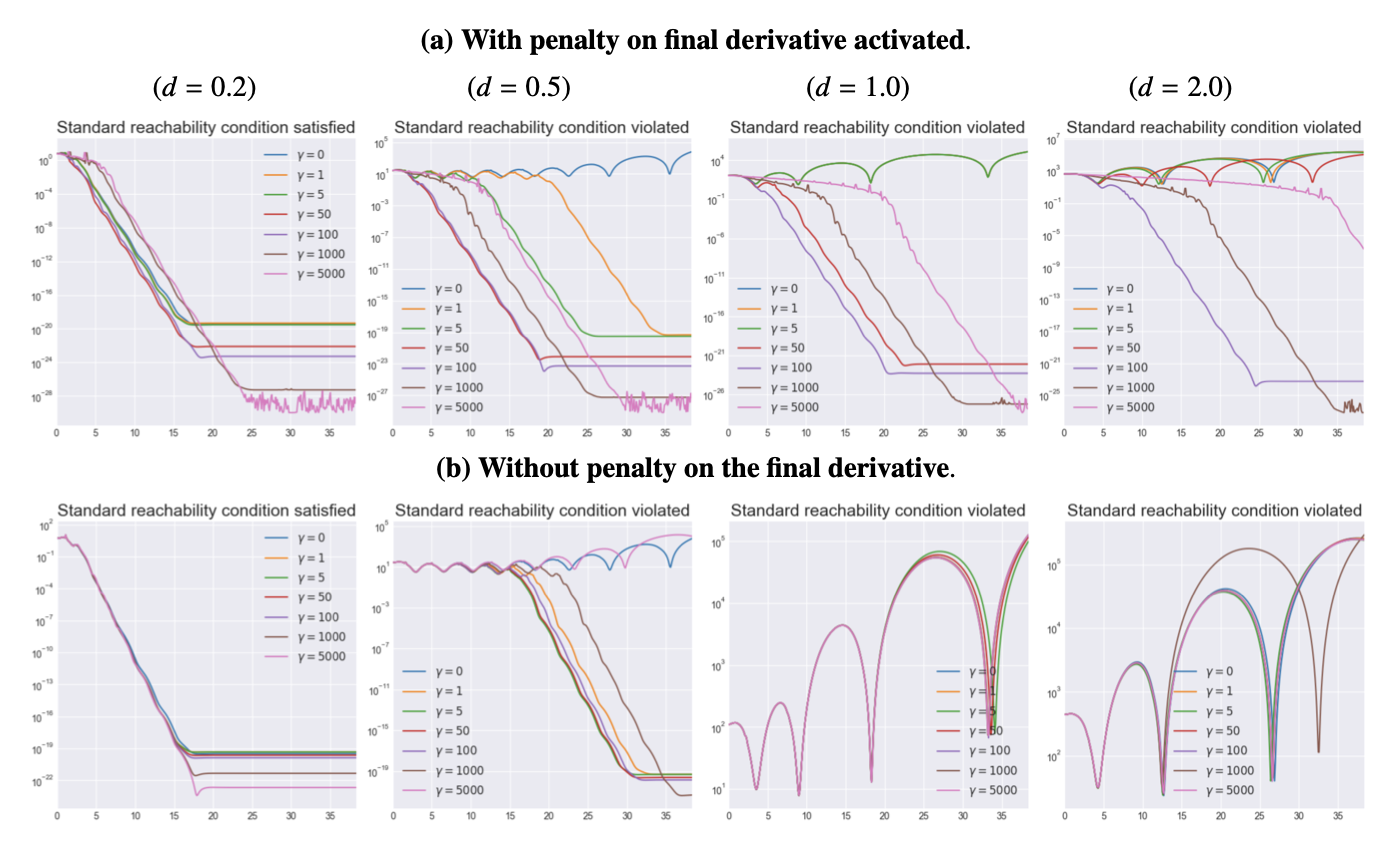
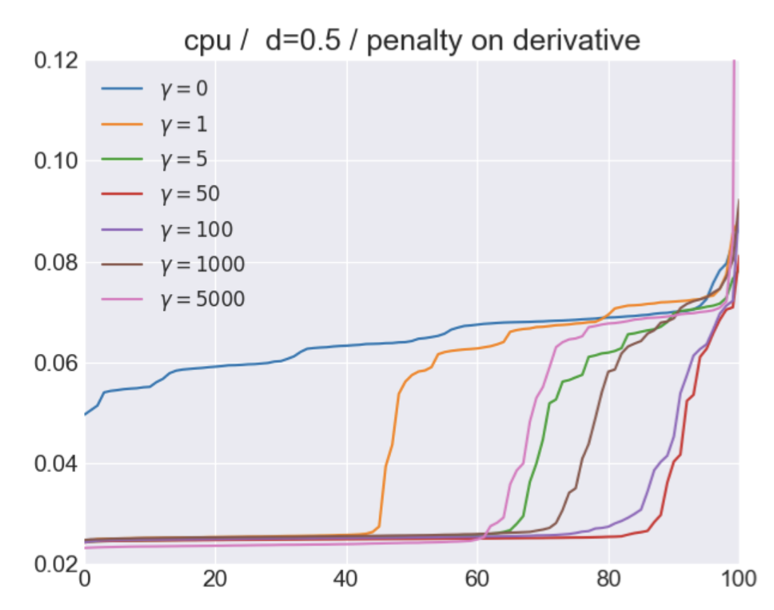
For more details, refer to the [paper].
Weighted increment-based formulation for economic MPC
Standard formulation of Economic MPC involkes weired concept such as rotated cost and passivity. The present formulation avoid these tricks and show that stability can be obtained using standard and intuitive point of view.
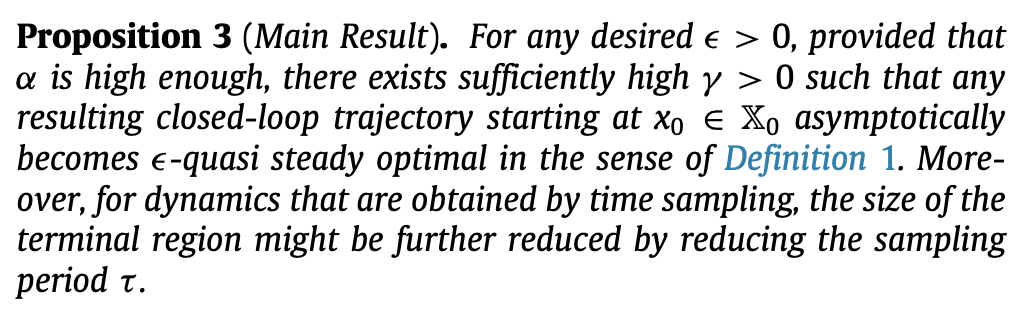
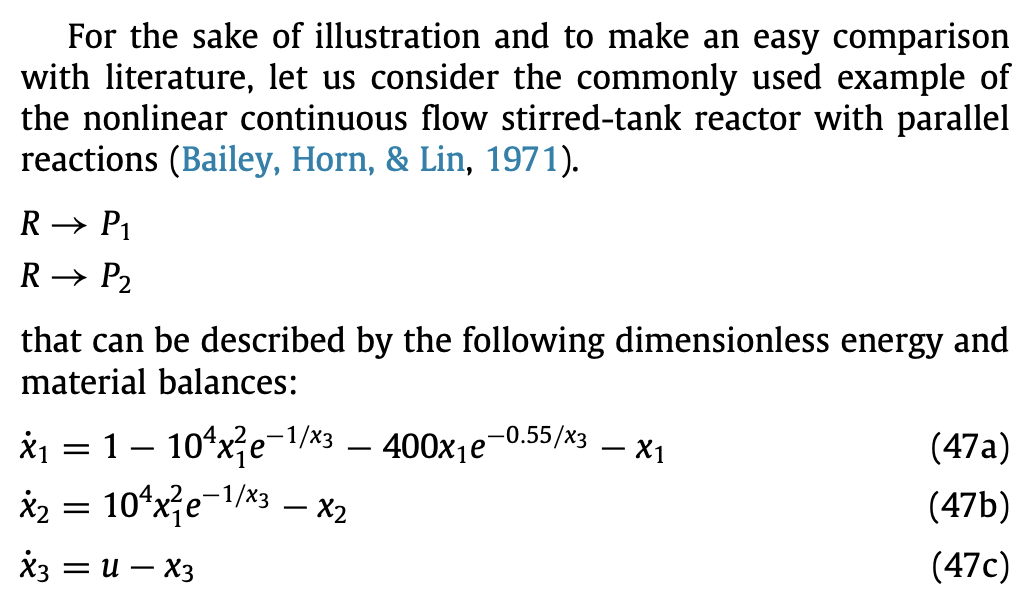
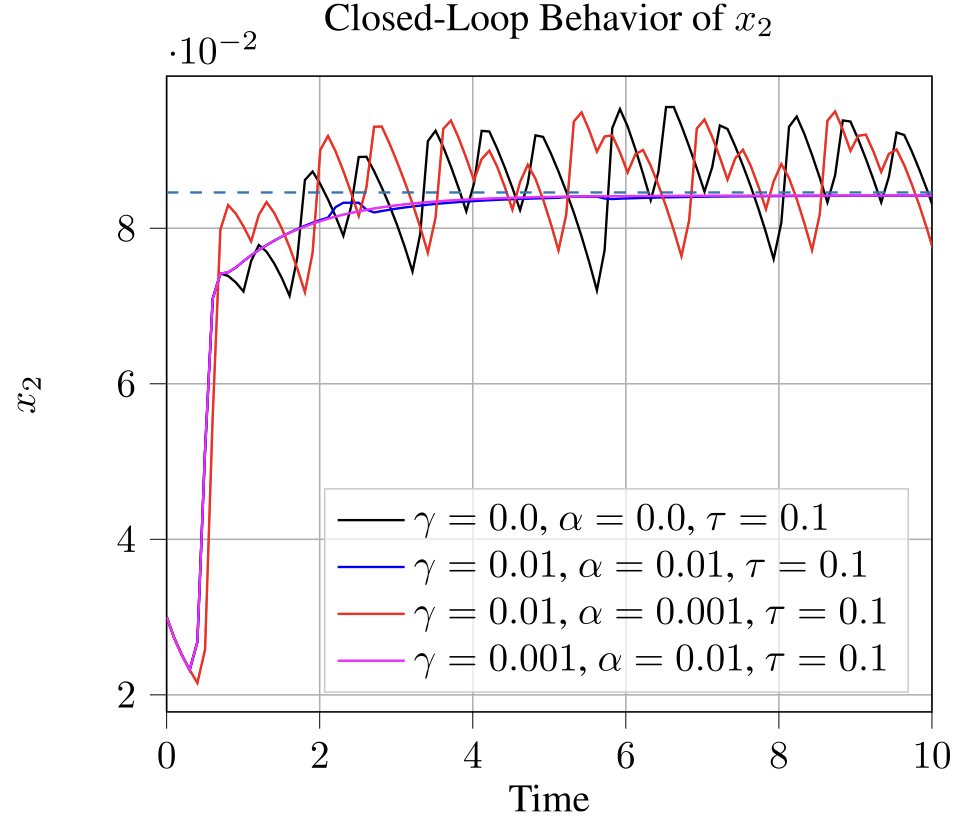
In this paper,it is shown that a simple formulation of Economic Model Predictive Control can be used which possesses two features that are generally viewed as mutually exclusive, namely, a rather short prediction horizon(reachability-compatible) on one side, and the absence of final constraint on the other side. Practical stability at an arbitrarily small neighborhood of the optimal unknown steady- state pair is shown when some design parameters increases. It is also shown that when the system is originated from the time discretization of a continuous-time dynamics, the size of the terminal region can be reduced by decreasing the sampling period for the same design parameter setting. A commonly used example is given to illustrate the results.
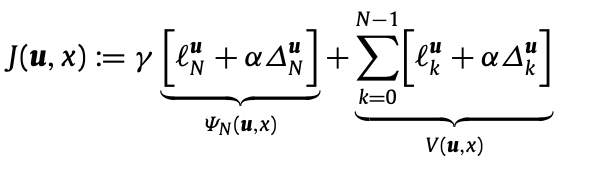
For more details, refer to the [paper].
Formulation with exponentially increasing penalty
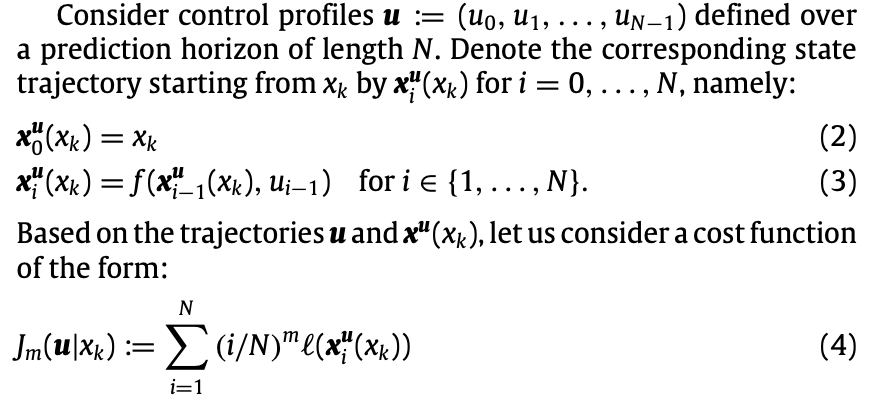
In this note, a new formulation of Model Predictive Control (MPC) framework with no stability-related terminal constraint is proposed and its stability is proved under mild standard assumptions. The novelty in the formulation lies in the use of time-varying monotonically increasing stage cost penalty. The main result is that the-reachability prediction horizon can always be made stabilizing without any terminal constraints provided that the increasing rate of the penalty is made sufficiently high. Moreover, it is shown through an illustrative example that the time varying penalty may improve the resulting closed-loop performance computed with the original stage-cost when compared to the traditional MPC formulation with final constraint on the state.
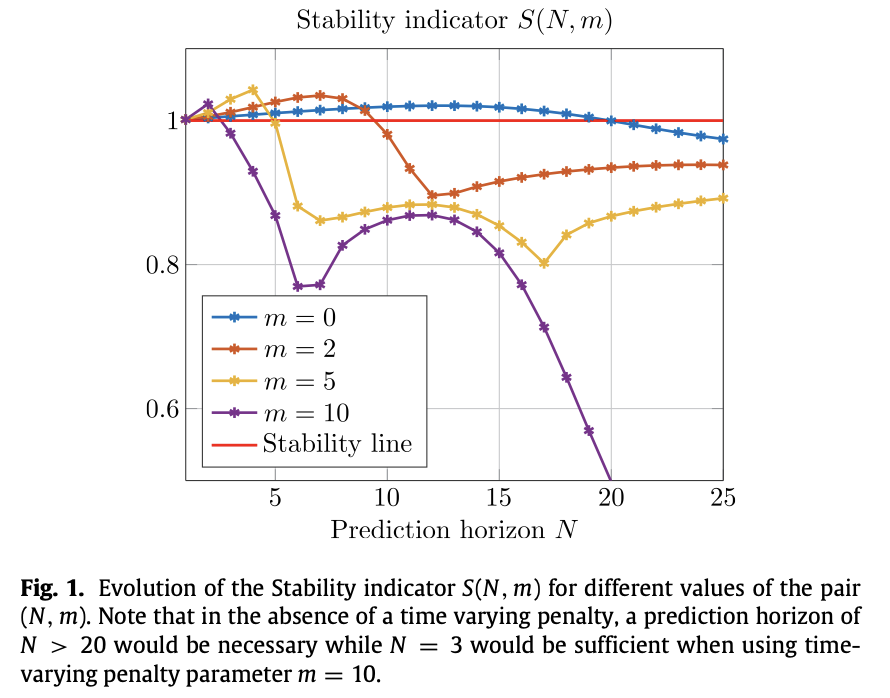
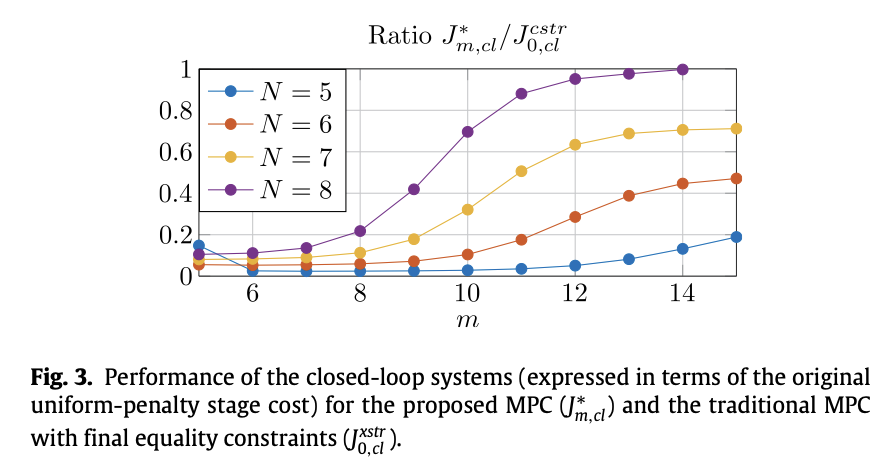
For more details, refer to the paper.
Contractive formulation without stability-related terminal constraint
Contraction-based nonlinear model predictive control (NMPC) formulations are attractive because they generally require short prediction horizons, and there is no need for the terminal set computation and reinforcement that are common requirements to guarantee stability. However, the inclusion of the contraction constraint in the definition of the underlying optimization problem often leads to non-standard features, such as a need for the multi-step open-loop application of control sequences or the use of multi-step memorization of the contraction level, which may cause unfeasibility in the presence of unexpected disturbances. In this study, we propose a new contraction-based NMPC formulation where no contraction constraint is explicitly involved. The convergence of the resulting closed-loop behavior is proved under mild assumptions. An illustrative example is provided in order to demonstrate the relevance of the proposed formulation.
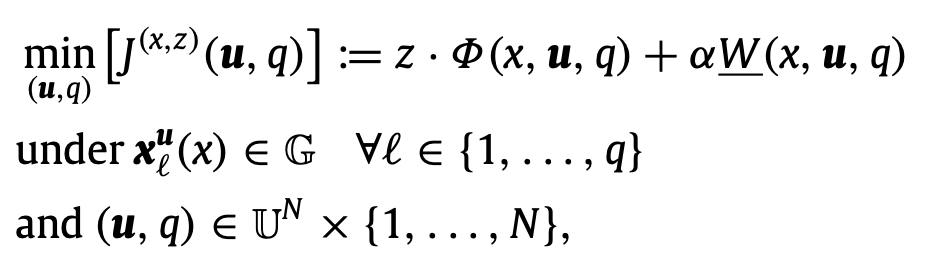
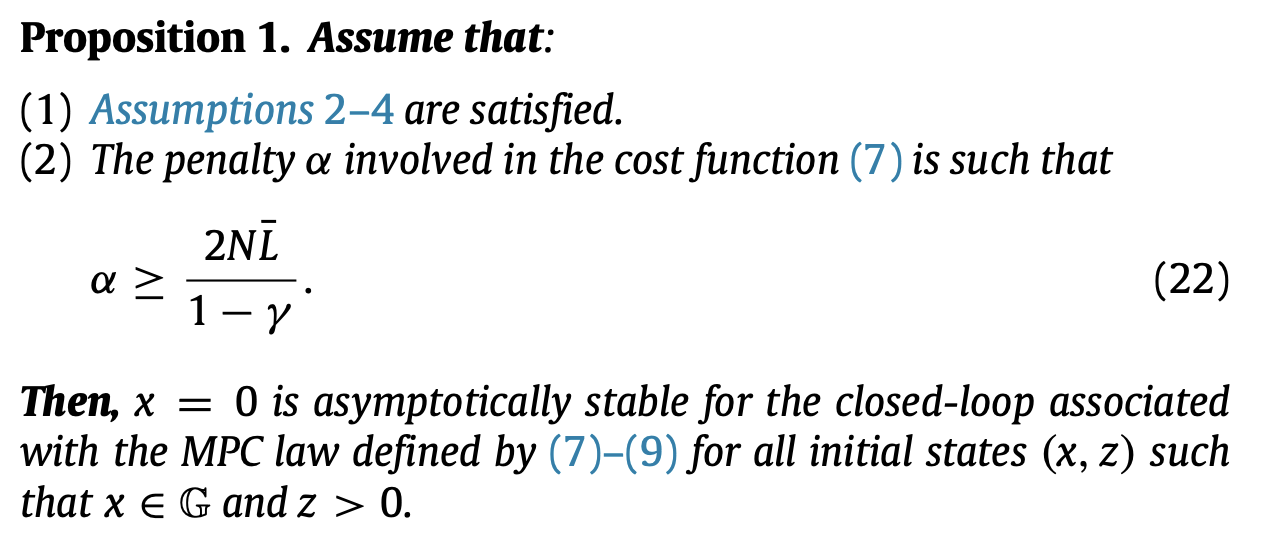
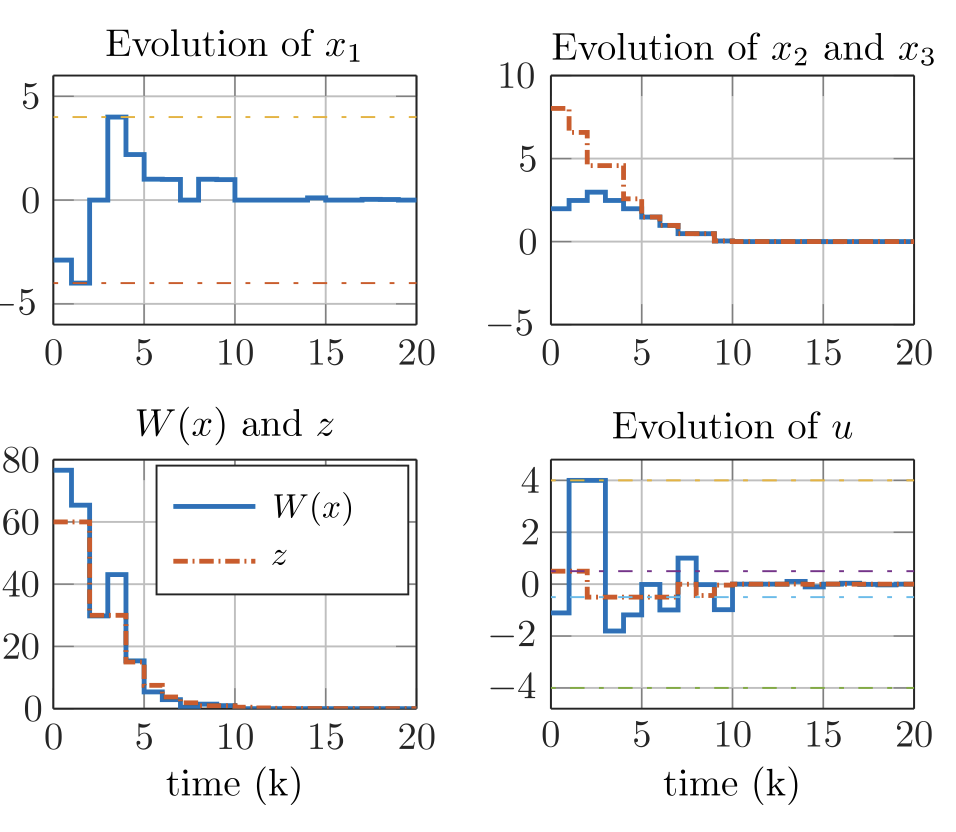
For more details, refer to the paper.
NMPC admissibility dashboard
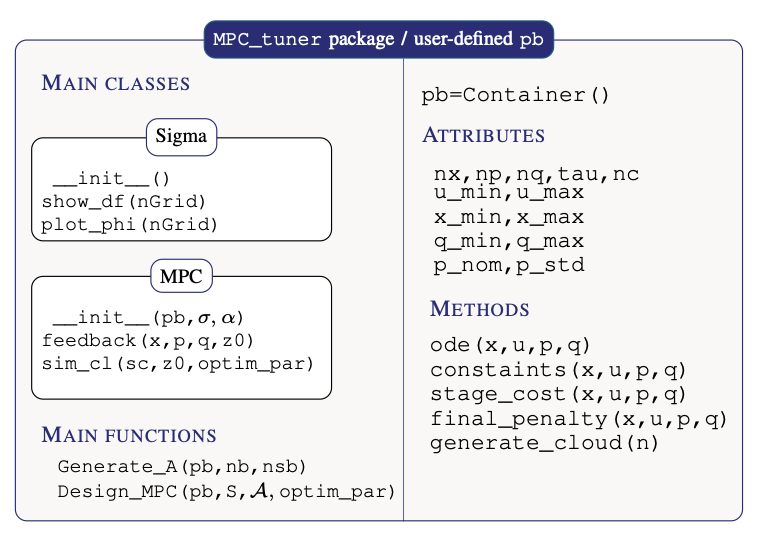
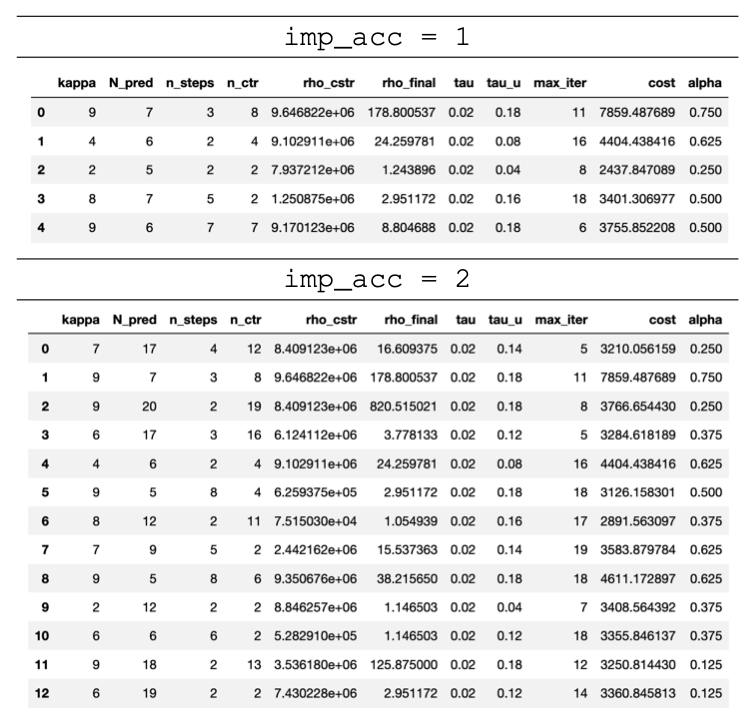
This brief presents a framework that delivers a certification-oriented dashboard of admissible nonlinear model predictive control (NMPC) implementation settings. This differs from the commonly adopted performance-centered tuning approaches by providing a dashboard of admissible setting options for which the optimal choice might be context-dependent. Some of the considered parameters are scarcely tuned in the literature on model predictive control (MPC)-parameter tuning such as the control updating period and the precision of the internal prediction. Moreover, a freely available Python-based implementation is also proposed, and typical results on an illustrative example are discussed highlighting the relevance of the contribution
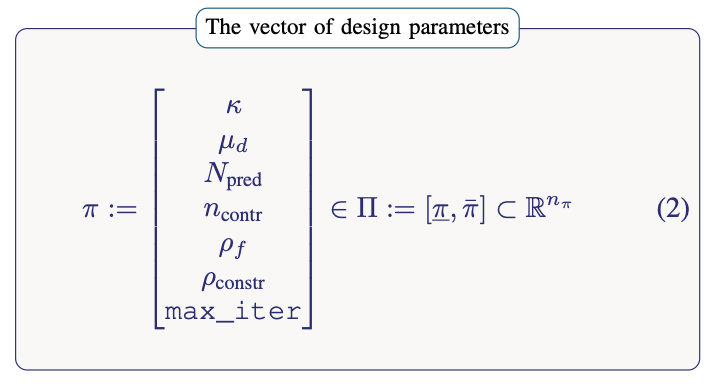
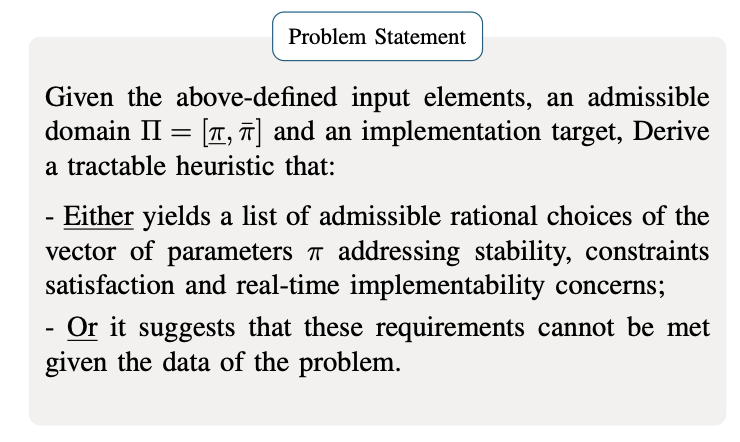
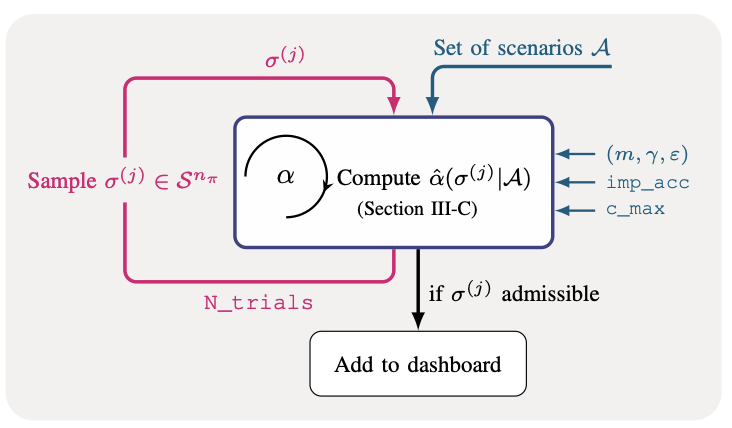
For more details, refer to the [paper].
Real-time considerations
GPU-Based parmeterized NMPC applied to semi-active suspension system
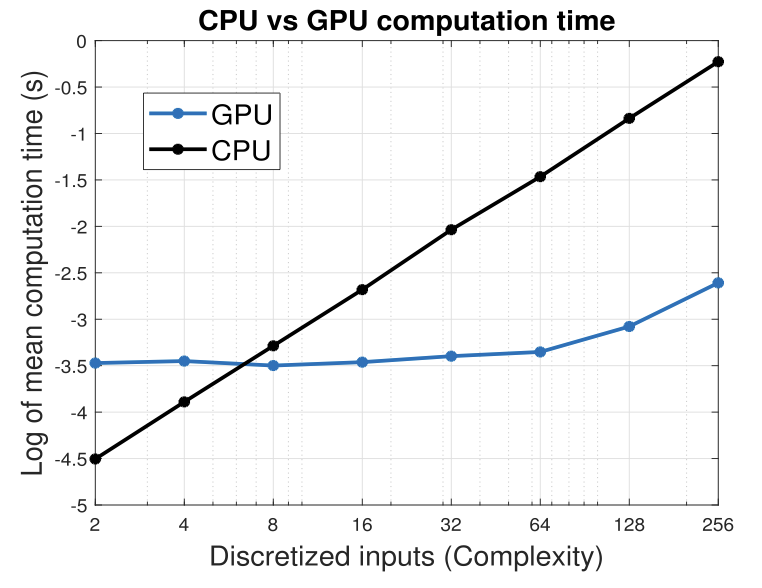
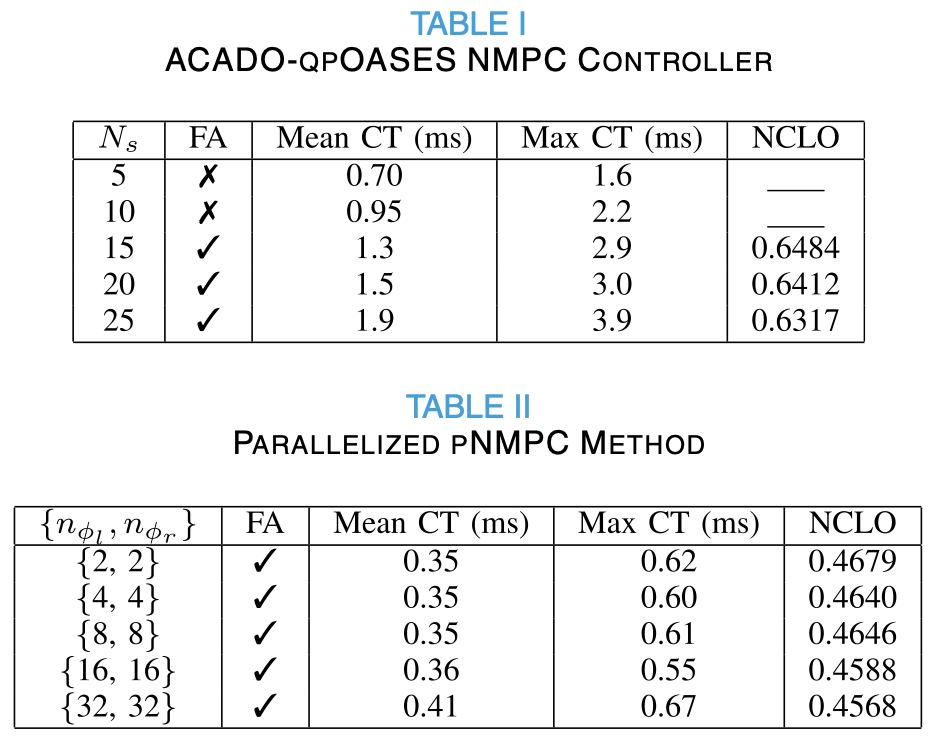
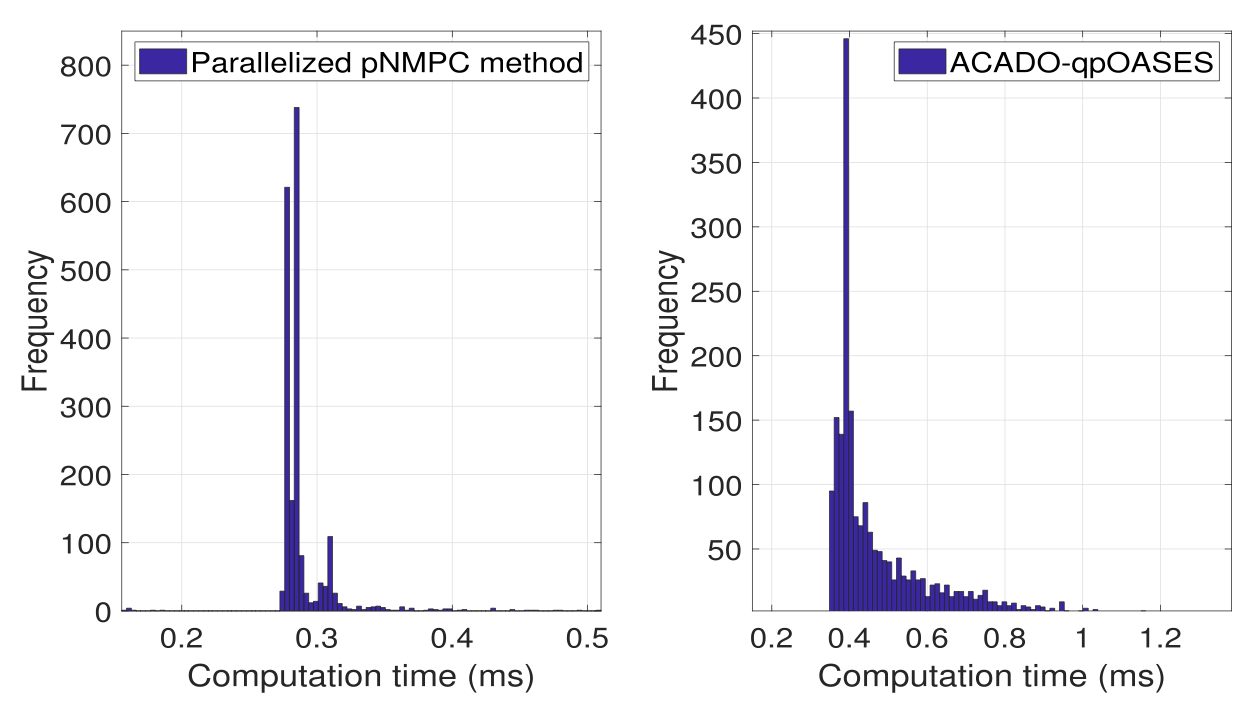
In this letter, we propose a black-box compatible simulation-based approach for solving nonlinear model predictive control (NMPC) problem via a parameterized technique to control the vertical dynamics of a half car vehicle equipped with semi-active (SA) suspension system. The method taps the potential of the graphic processing unit (GPU) to simulate the system parallelly for several combinations of control inputs and the optimal input is elicited which minimizes the objective function and satisfies the constraints. The method was tested in MATLAB/Simulink environment by means of simulations and a comparative study was conducted with ACADO-qpOASES NMPC framework. The simulation results display better performance of the proposed approach in terms of computation time, closed loop objective, and constraint satisfaction when juxtaposed to the ACADO-qpOASES NMPC controller.
For more details, refer to the [paper].
Stochastic MPC by supervised clustering
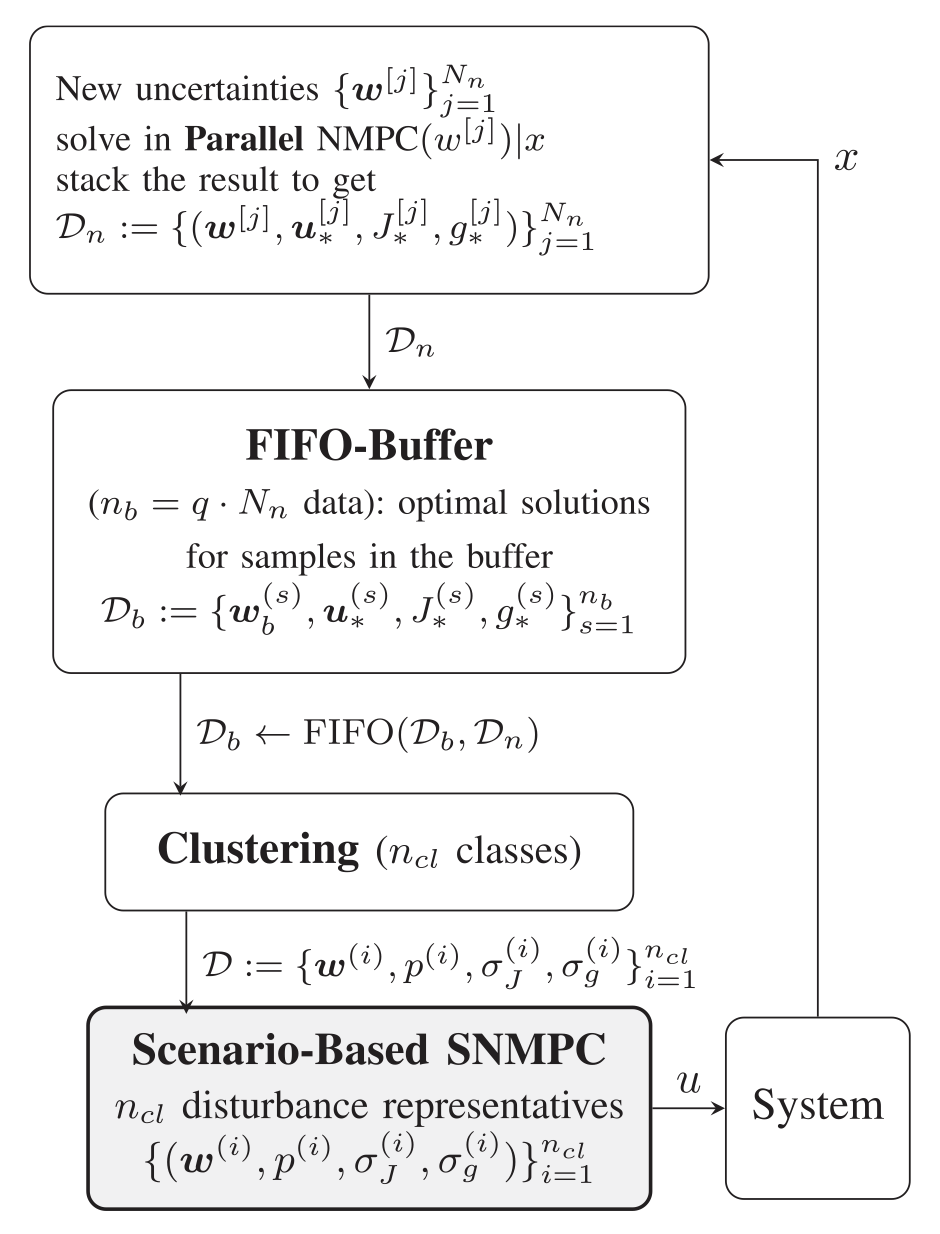
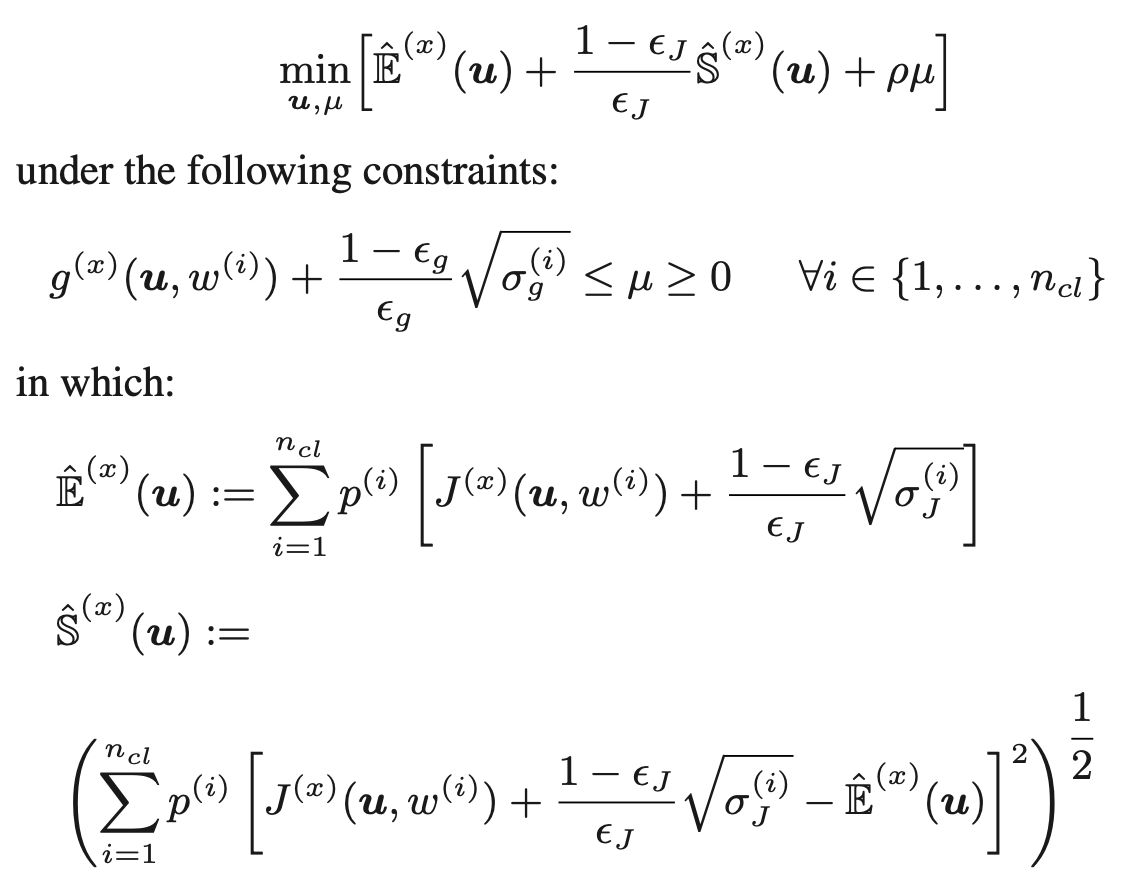
In this article, a supervised clustering-based heuristic is proposed for the real-time implementation of approximate solutions to stochastic nonlinear model predictive control frameworks. The key idea is to update online a low cardinality set of uncertainty vectors to be used in the expression of the stochastic cost and constraints. These vectors are the centers of uncertainty clusters that are built using the optimal control sequences, cost, and constraints indicators as supervision labels. The use of a moving clustering data buffer which accumulates recent past computations enables to reduce the computational burden per sampling period while making available at each period a relevant amount of samples for the clustering task. A relevant example is given to illustrate the contribution and the associated algorithms
Cost Function

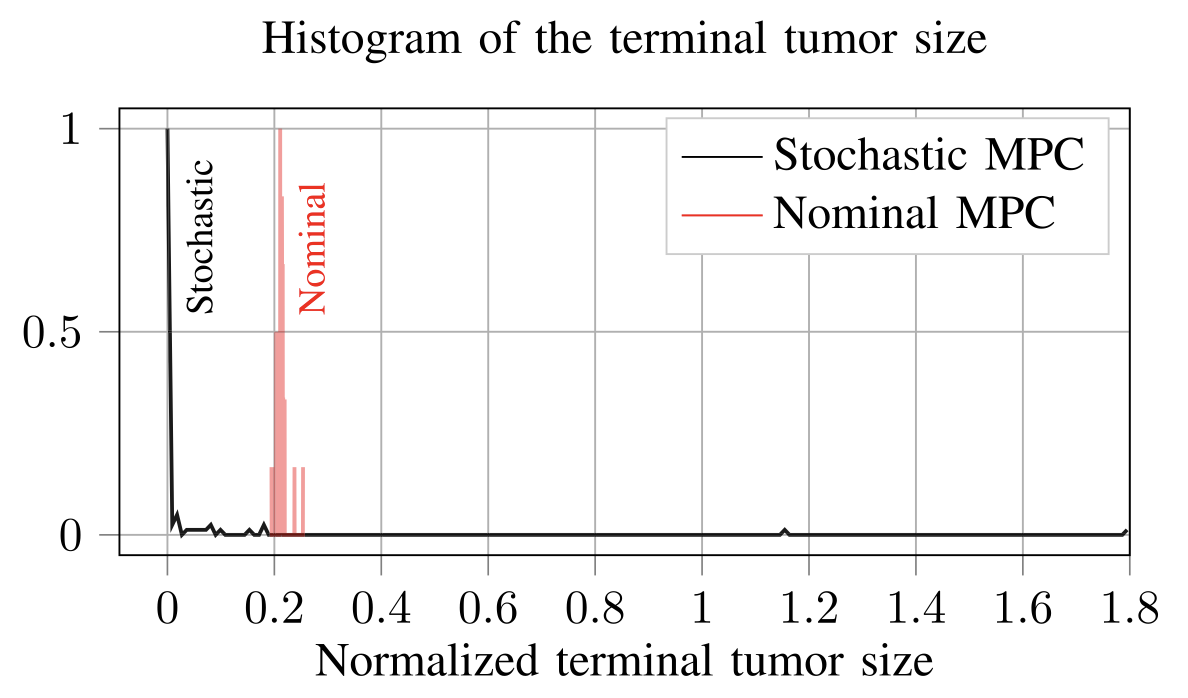
For more details, refer to the [paper].
Hierarchical NMPC: Application to cryogenic refrigerators
This paper presents an extension of a recently proposed hierarchical control framework applied to linearization-based unconstrained control of a cryogenic refrigerator. The extension concerns the validation of the framework in the presence of both nonlinear models and constraints. It is also shown that real-time handling of these features requires a specific complexity reduction technique. This technique performs the distribution of the optimization process over cyclically changed decision variables aiming at limiting the number of iterations per updating period. Numerical simulations are proposed in order to show the impact of the parameters choices and to assess the real-time implementability of the proposed framework.
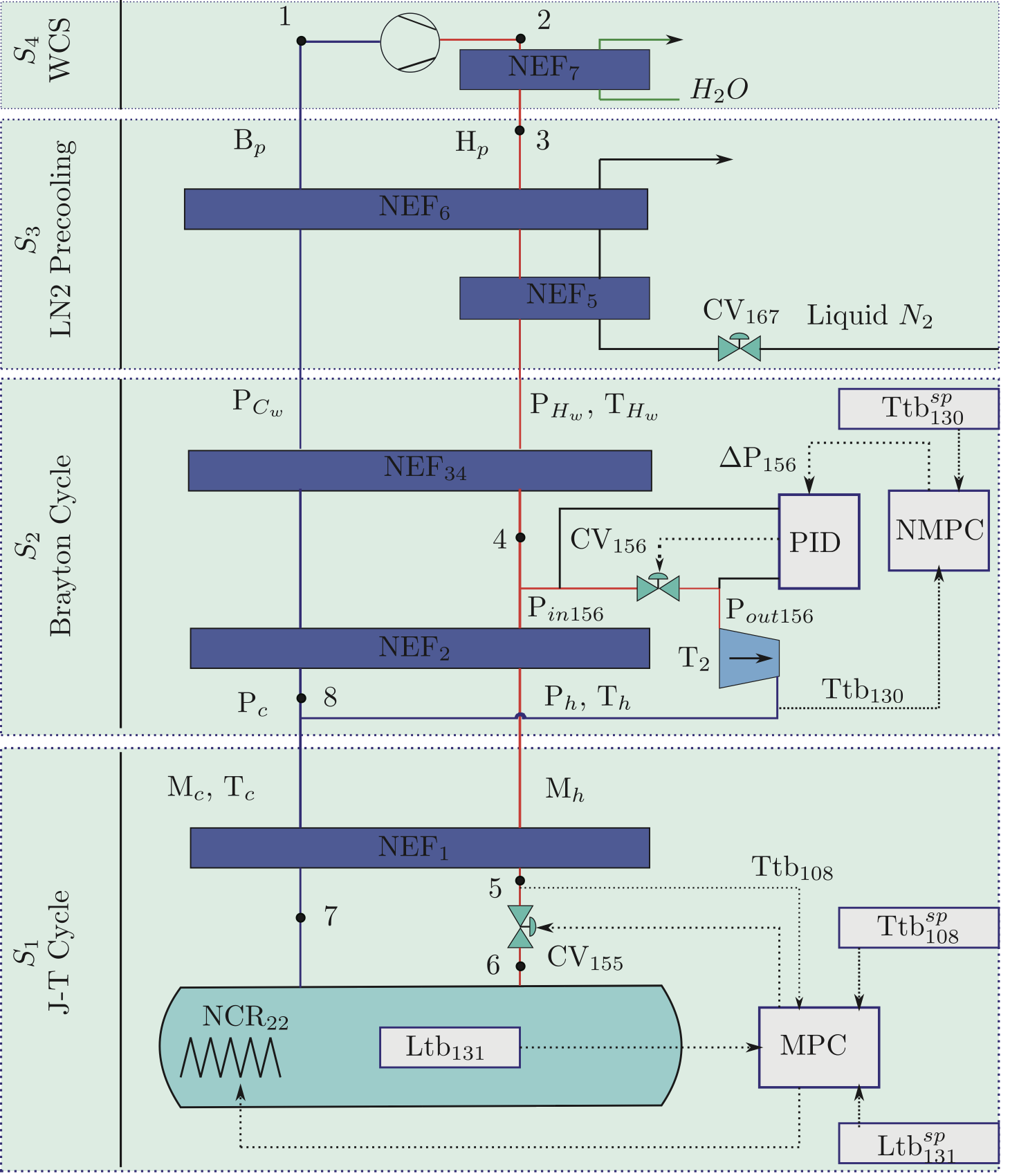
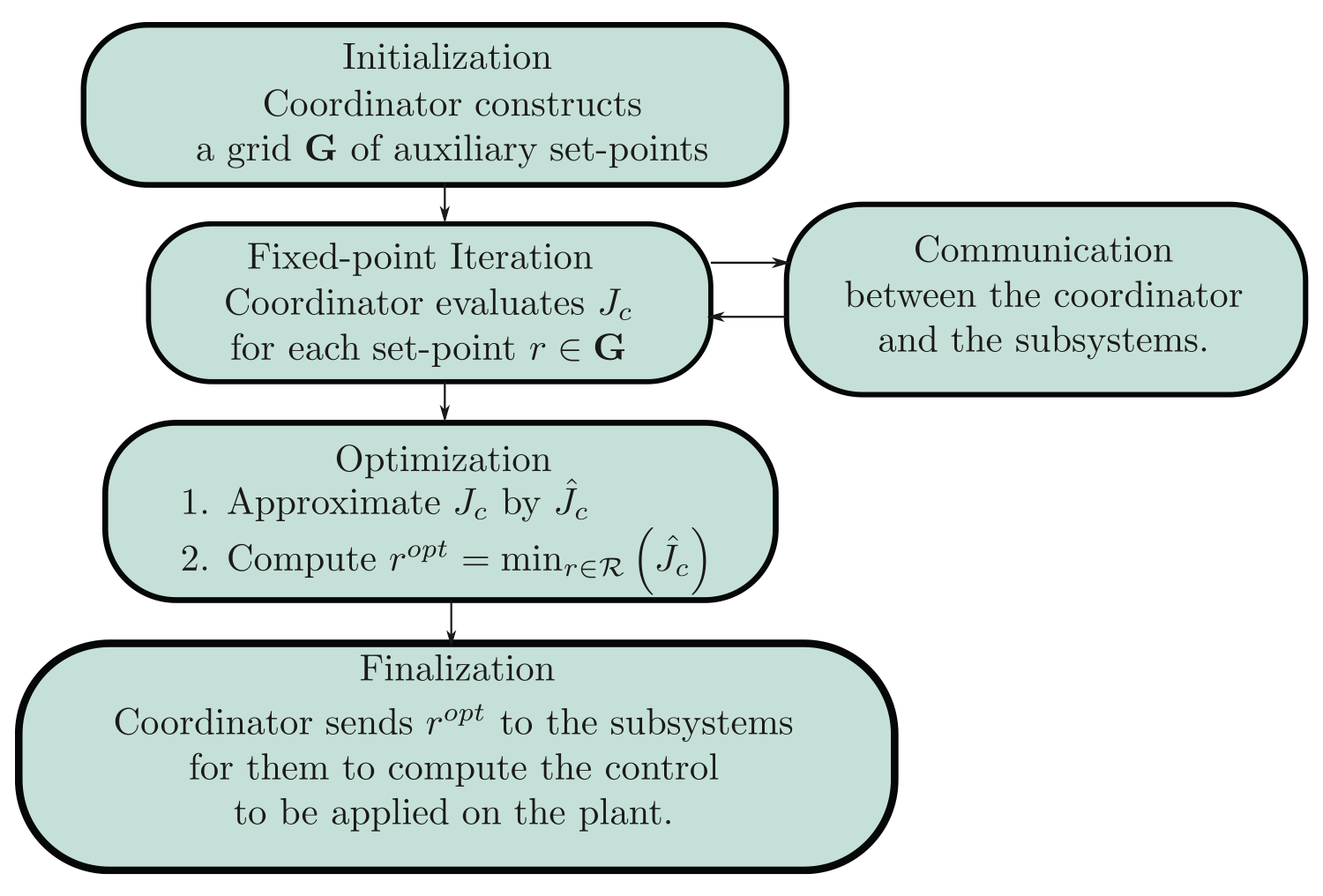
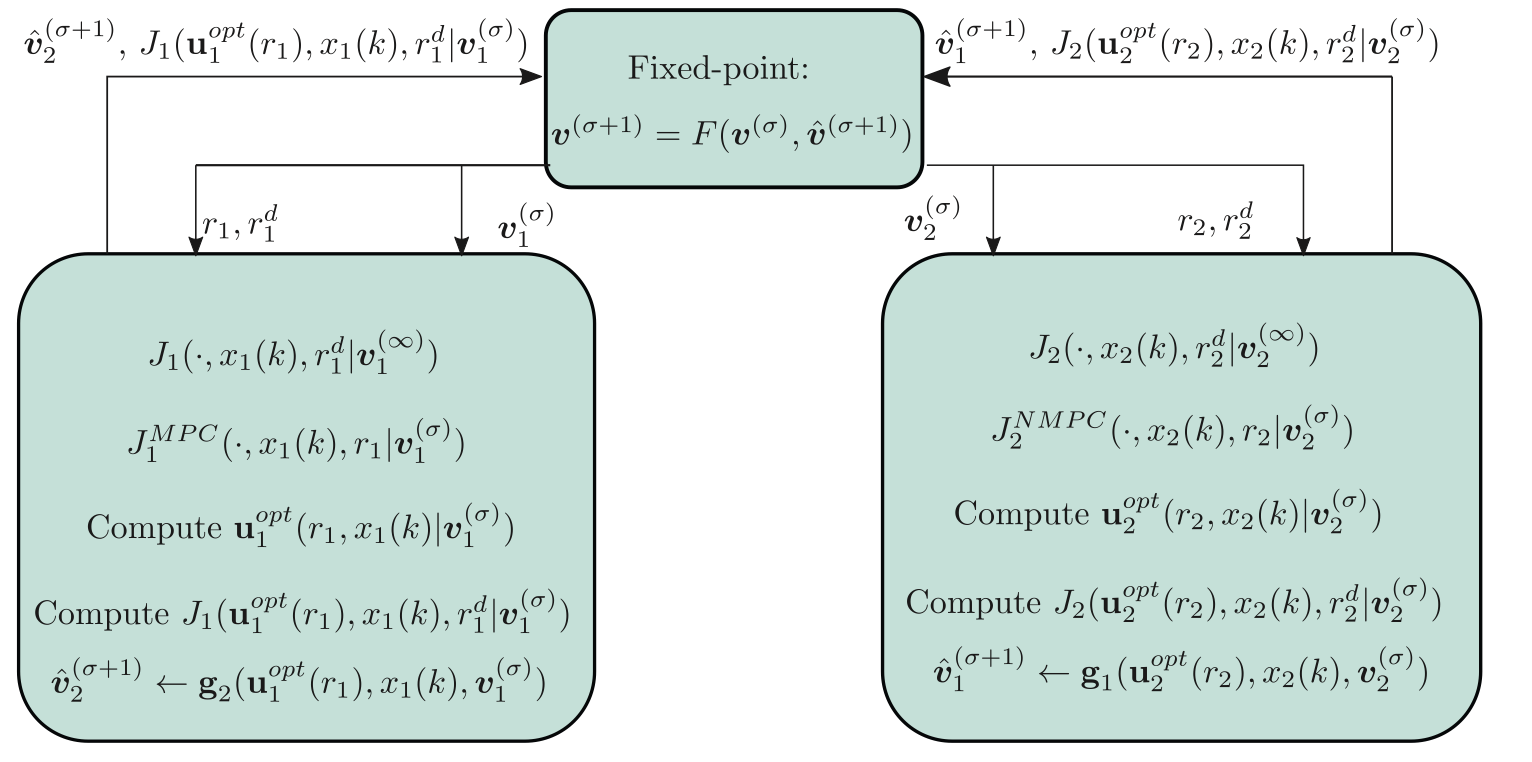
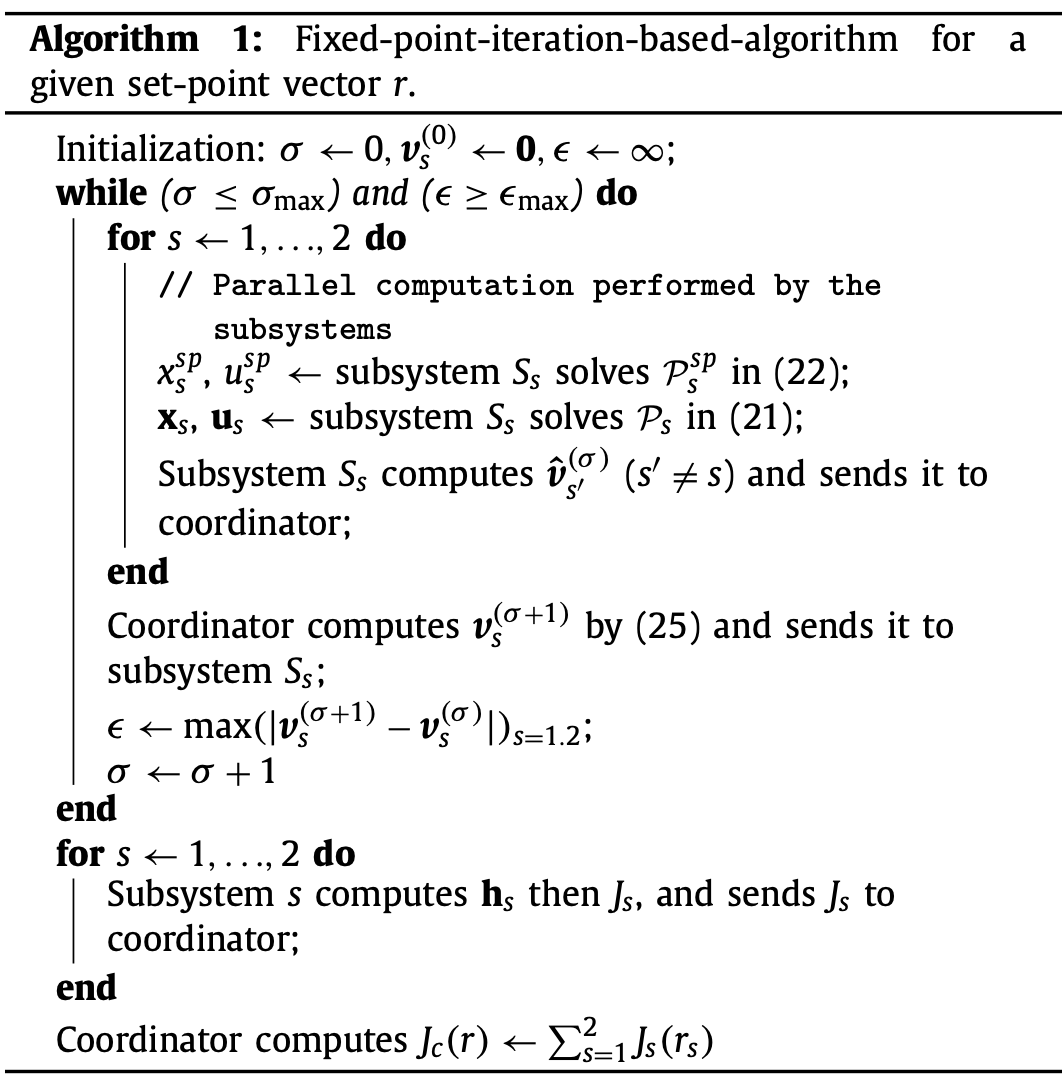
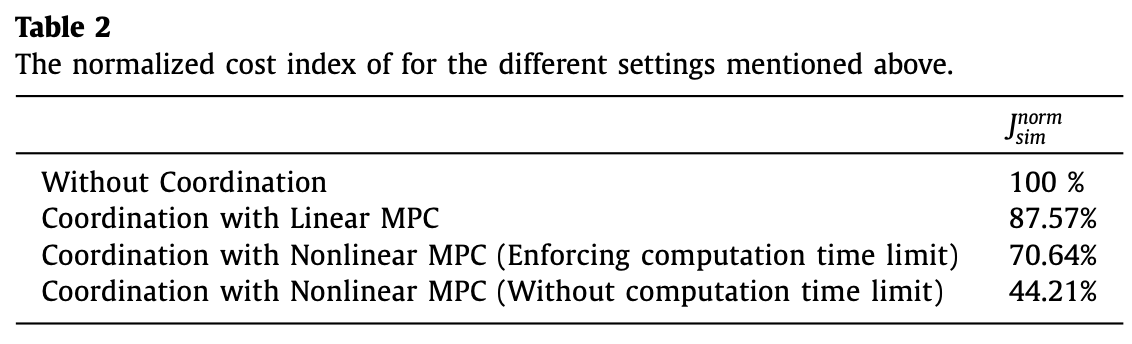
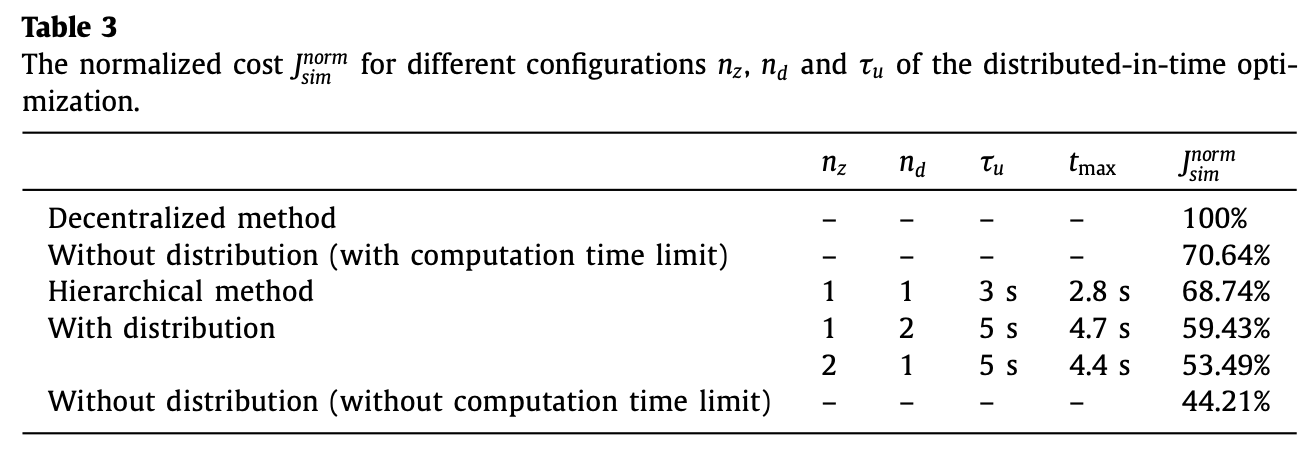
Achieved closed-loop cost under different settings of the controller. (a) without distributing the computation time over the system’s lifetime (b) under different setting of the distribution-in-time implementation.
For more details, refer to the [paper]. Notice that this work is an extension of [a previous work] which tackled only a network of unconstained linear dynamical system. The work presented here extends the previous one to networks of possibly nonlinear system involving general constraints.
Course on Nonlinear Model Predictive Control
Here is a [jupyter notebook-based course] with executable cells and slides.
For some reason, it happens that the pdf slides are displayed only on mozilla Firefox navigator.